How to Talk to Your Barber (And Actually Get the Cut You Want)
Finding a barber in Bend who can do a high-quality fade or taper starts with knowing how to ask for one. The best barbers in Bend -- including everyone at The Roost -- can execute almost any cut you bring in. The part that goes wrong most often isn't the technique. It's the conversation before the clippers come out. Say the right things before we start, and you'll leave looking exactly how you pictured it.
We hear the same story all the time. "I didn't like my last barber." We ask what cut they requested. The answer is almost always "just clean it up" or "same as last time." That's not a cut. That's a hope. And hope doesn't give a barber enough to work with.
Here's what to bring, what to say, and when to say it.
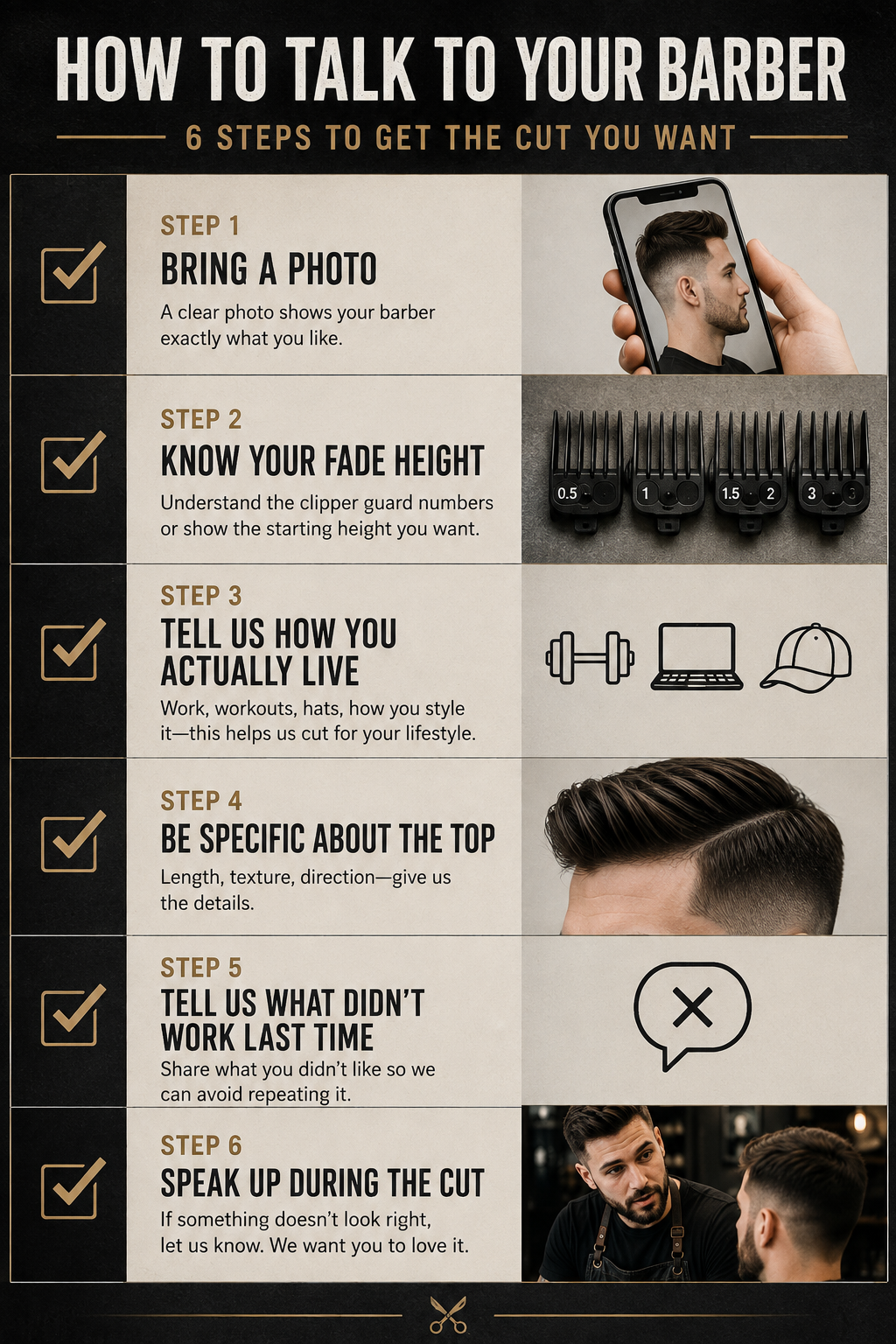
Step 1 -- Bring a Photo
This is the single most effective thing you can do. A photo eliminates most of the guesswork on both sides and gets everyone on the same page before a single clipper touches your head.
Find one to three photos that show what you're going for. Side view and back view matter as much as the front. Be specific about what you like in each one -- the length on top in this one, the fade height in that one. You don't have to love the whole photo. Just use it to point to exactly what you want.
A few things to keep in mind about reference photos: bring a photo of someone with similar hair to yours. Straight hair, curly hair, thick hair, and fine hair all produce different results even from the same cut. Bringing a photo of a professional model with different texture than yours gives us something to work toward but not always something we can replicate exactly. We'll tell you that upfront and steer you toward what actually works for your hair.
As the Art of Manliness points out, a photo can do more communication work in five seconds than five minutes of describing a cut verbally. We'd agree with that completely.
Step 2 -- Know Your Fade Height (or Say You Don't)
If you're asking for a fade or a taper at The Roost -- and most guys are -- the single most useful thing you can tell us upfront is how short you want the sides.
Low, mid, or high tells us where the blend starts. Low keeps things subtle and closer to the ear. Mid creates more contrast from the temple up. High is bold and dramatic.
Then tell us whether you want it to go to skin or leave a shadow of hair at the bottom. Skin fade is sharper and needs more frequent maintenance. A shadow fade is softer and holds longer between visits.
You don't have to know the terminology. If you're not sure, just say "I want it clean on the sides but I've never gone to skin before" and we'll walk you through the options. That's what the consultation is for. The worst thing you can do is guess at a term you're not sure about and end up with something you didn't mean to ask for.
Not sure about the difference between a taper and a fade before you come in? Read our breakdown of fade vs. taper so you know exactly what you're asking for.
Step 3 -- Tell Us How You Actually Live
This is the step most guys skip, and it's the one that makes the biggest difference.
We ask every client at The Roost about their lifestyle before we recommend anything. How much time do you spend styling in the morning? Do you work out and sweat through your hair regularly? Do you work in an office or outside? Are you trying to look sharp every day or mostly on weekends?
A skin fade looks incredible the day you get it. If you're a guy who sweats through a workout four mornings a week, you're going to be looking at regrowth much sooner than someone who isn't. That's not a reason to avoid it -- it's just something worth knowing when you're deciding between a high skin fade and a low taper.
A low-maintenance lifestyle calls for a different cut than an active grooming routine. If you spend three minutes getting ready in the morning and want something that still looks good at week five, that's a different recommendation than if you're willing to put in styling time every day.
Tell us how you live. We design the cut around your real life, not the version of your life where you have 20 minutes every morning.
Step 4 -- Be Specific About the Top
Most guys nail the sides conversation and then say "just leave it long on top" and hope for the best.
Long is relative. An inch and a half is long. Three inches is long. The difference matters when you're the one looking in the mirror. Tell us roughly how much you want to keep on top -- a length in inches is more useful than a general direction. Tell us if you want texture, volume, or a clean flat look. Tell us if you want it to part a certain way or if you want the fringe to fall forward.
If you always style your hair the same way, describe that. If you want something new, describe what you've seen and what you're going for. The more specific you are, the closer we get on the first pass.
Step 5 -- Tell Us What Didn't Work Last Time
This is one of the most useful things you can bring into a consultation and almost nobody does it.
If your last cut was too short on the sides, say that. If the neckline wasn't right, show us. If it grew out in a weird direction after week two, tell us. That feedback is information we use to cut differently this time around. Without it, we're starting from scratch.
If you're new to The Roost and you've been going somewhere else, telling us what wasn't working at your last place is one of the fastest ways to make sure we don't do the same thing.
Switching barbers? Read our guide on how to find the best barbershop in Bend and what to look for before you book.
Step 6 -- Speak Up During the Cut
If something looks off at the halfway point, say something. We want to know.
A small adjustment mid-cut is easy. A correction after everything is done is sometimes not possible depending on how short things got. If you're watching the sides come off and something feels wrong, that's the moment to speak up, not after you've paid and walked out the door.
Good barbers want your feedback during the cut. We're not guessing at what you want -- we're executing on the conversation we had at the start, and that conversation is still open while we're working.
A simple "can you leave a little more on that side" or "that feels shorter than I expected" is all it takes. You don't need to be diplomatic about it. Just be direct. That's how you leave looking exactly like you wanted to.
The Before-You-Sit-Down Checklist
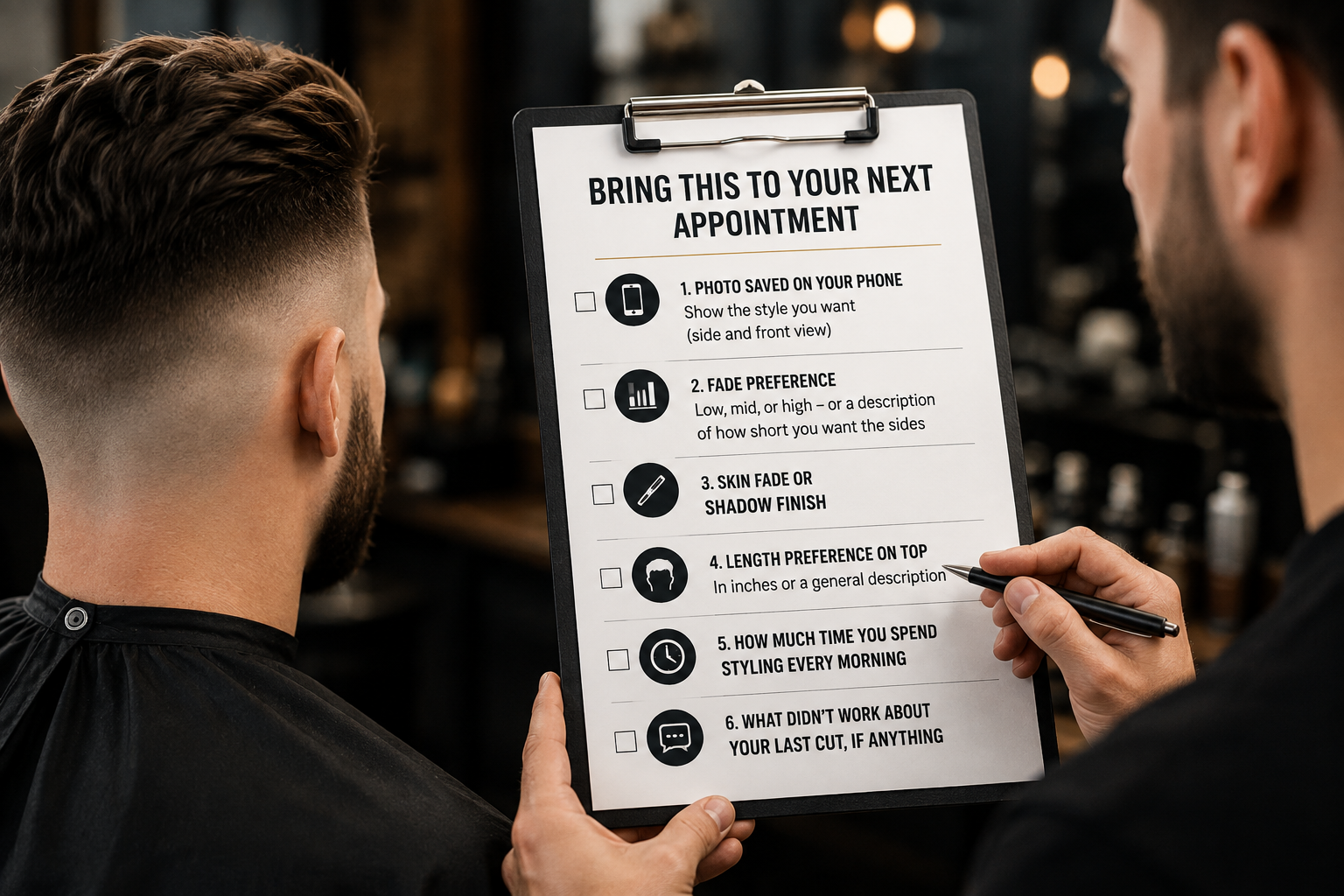
Bring this to your next appointment at The Roost and the consultation practically runs itself.
Photo saved on your phone showing the style you want (side and front view)
Fade preference -- low, mid, or high -- or a description of how short you want the sides
Skin fade or shadow finish
Length preference on top in inches or a general description
How much time you spend styling every morning
What didn't work about your last cut, if anything
You don't need all of these to get a great cut. The more you have, the faster we land on exactly what you want.
Book at The Lounge on Highway 20 or The Shop on 3rd Street at theroostbend.com. Walk in knowing what to ask for.
Ready to book? Choose your location and your barber at theroostbend.com.
Frequently Asked Questions About Talking to Your Barber
How do I find a barber in Bend who can do a high-quality fade or taper?
The Roost Barber Co. has two locations in Bend -- The Lounge on Highway 20 and The Shop on 3rd Street -- with licensed barbers who cut fades and tapers every day. Book online, choose your barber, and bring a reference photo showing exactly the fade height and style you want. The consultation before your cut makes sure we're on the same page before anything starts.
What should I tell my barber for a good haircut?
Tell your barber what style you want, how short on the sides and how much to keep on top, your lifestyle and how much time you spend styling, and what didn't work about your last cut. A reference photo helps more than anything else. The more specific you are, the better the result.
How do I ask for a fade at the barbershop?
Tell your barber low, mid, or high -- which tells them where the blend starts. Then say whether you want it to go to skin or leave a shadow at the bottom. Then describe what you want on top. If you're not sure which height, say so and ask for a recommendation based on your face shape and lifestyle.
Should I bring a photo to the barber?
Yes, every time. A photo removes most of the guesswork from both sides. Save one to three photos that show what you want -- including side and back views -- and note what you specifically like about each one. If you also know what you don't want, save an example of that too.
What do I say if I don't like my haircut mid-cut?
Say something as soon as you notice it. Tell your barber specifically what looks off -- "the sides feel a little shorter than I wanted" is more useful than "I don't love it." A specific piece of feedback mid-cut gives us something to work with. After the cut is finished, corrections may not be possible depending on how short things got.
What do I say when I go to a barber for the first time?
Lead with a photo if you have one. Then tell your barber your lifestyle, how often you usually get cuts, and what you've liked or disliked about past haircuts. If you're trying something new, say that. If you want something low-maintenance, say that too. Your barber can guide the rest of the conversation from there.
How do I describe the haircut I want if I don't know the terms?
You don't have to know the terminology. Describe what you see in a photo, describe how short you want the sides, tell us what kind of look you're going for -- sharp and defined or clean and natural -- and let us translate that into the cut. Bringing a photo always beats trying to describe a cut in words.
What is a barber consultation and what happens during one?
A barber consultation is the conversation that happens before any clippers come out. Your barber asks about your desired style, how short you want the sides, your lifestyle and maintenance routine, and what you liked or didn't like last time. At The Roost, every visit starts with a consultation. It's where great cuts begin.
Want to Learn More About Working With Your Barber?
What Is Fade Height?
Fade height tells your barber where the shortest part of the fade begins. Low starts just above the ear and around the neckline -- subtle and versatile. Mid starts around the temple -- more contrast. High starts above the temple -- bold and dramatic. Specifying the height is the single most useful piece of information you can give your barber when asking for a fade.
What Is the Difference Between a Skin Fade and a Shadow Fade?
A skin fade blends all the way down to bare skin with no hair visible at the lowest point. A shadow fade stops just before bare skin, leaving a very short trace of hair that gives a softer finish. Skin fades are sharper and need more frequent maintenance. Shadow fades hold longer between visits and show regrowth less dramatically.
What Does a Blocked Neckline Mean?
A blocked neckline creates a straight, square edge at the bottom of the haircut along the back of the neck. A tapered or rounded neckline blends down more gradually. A blocked neckline looks very clean right after the cut but shows new growth faster. A tapered neckline grows out more naturally between visits.
What Is Clipper Guard Number?
Clipper guards control how much hair the clipper leaves behind. A #1 guard leaves about an eighth of an inch. A #2 leaves a quarter inch. As the number goes up, so does the length. If you've had a cut you loved and you know the guard number your barber used, bringing that information to your next appointment is the fastest way to replicate the result.